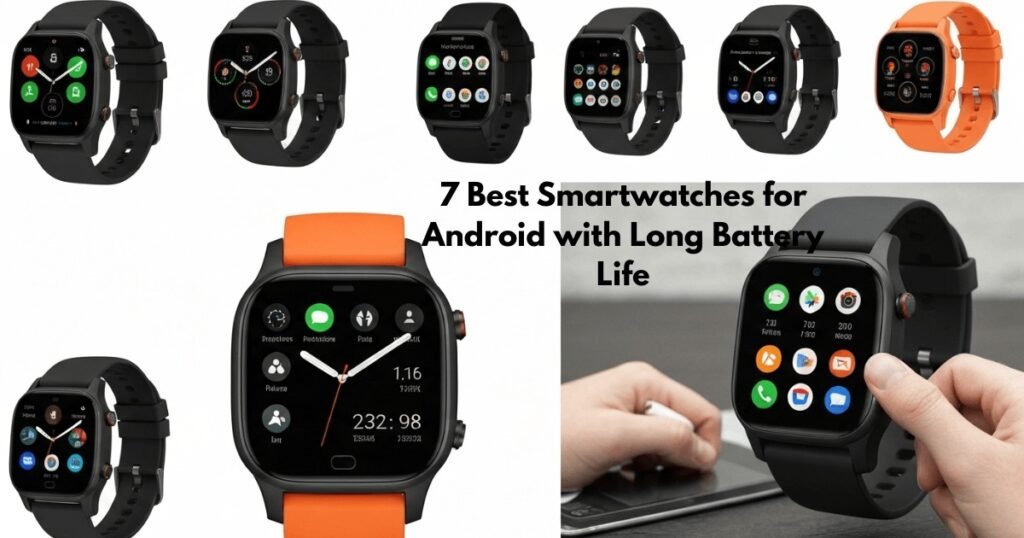
Meta Description: Discover the Best smartwatches for Android with long battery life. Expert reviews on Garmin, Samsung, and OnePlus optimized for Wear OS 6 and solar power.
For years, the “smartwatch tax” meant charging your device every single night. If you forgot, you woke up to a dead screen and a gap in your health data. But in 2026, the landscape has shifted. Thanks to breakthroughs in Silicon Nanostack battery technology and the hyper-efficiency of Wear OS 6, the “daily charge” is becoming a relic of the past.
Best smartwatches for Android with long battery life
Whether you are an ultra-marathoner needing 300 hours of GPS or a corporate professional wanting a full work week of “smart” features without hunting for a puck charger, there is now a device built for your endurance needs. This guide breaks down the absolute best Android-compatible smartwatches that prioritize longevity without sacrificing the cutting-edge AI and health sensors that define a modern wearable.
The 2026 Endurance Leaderboard
| Model | Operating System | Typical Battery Life | Best For |
| Garmin Enduro 3 | Garmin OS | 30–90 Days (Solar) | Ultra-Endurance & Expeditions |
| OnePlus Watch 3 | Wear OS 6 + RTOS | 5–7 Days | Best Balance for Power Users |
| Samsung Galaxy Watch Ultra | Wear OS 6 | 48–100 Hours | Premium Rugged & Ecosystem |
| Mobvoi TicWatch Pro 6 | Wear OS 6 | 90 Hours | Dual-Display Enthusiasts |
| Google Pixel Watch 4 | Wear OS 6 | 60 Hours | AI Features & Style |
| Xiaomi Watch S4 | HyperOS | 15 Days | Budget Longevity |
| Withings ScanWatch 3 | Analog Hybrid | 30 Days | Health-First Minimalists |
1. The Endurance King: Garmin Enduro 3
The Garmin Enduro 3 remains the undisputed heavyweight champion of longevity. While other brands measure battery life in hours, Garmin measures it in months.
Using an improved Power Glass solar lens, the Enduro 3 harvests light more efficiently than any predecessor. If you spend three hours a day outdoors in 50,000 lux conditions, you can theoretically reach up to 90 days in smartwatch mode.
Why it matters: For B2B field workers or extreme athletes, the Enduro 3 provides 320 hours of continuous GPS tracking. It features a transflective MIP (Memory-in-Pixel) display that actually gets clearer in direct sunlight, unlike traditional AMOLED screens that drain power to fight glare.
-
Who it’s for: Thru-hikers, ultra-runners, and off-grid professionals.
-
Key Tech: Solar harvesting, SatIQ™ (auto-selecting the best GPS signal to save power).
2. The Wear OS Champion: OnePlus Watch 3
The OnePlus Watch 3 has perfected the “Dual-Engine Architecture.” Inside, two brains work in tandem: the Snapdragon W5 Gen 2 handles power-hungry Google Play apps, while the high-efficiency BES2800 co-processor manages background tasks like heart rate and notifications.
Unlike the “one-day” watches of old, the OnePlus Watch 3 comfortably hits 120 hours (5 days) of full smartwatch use. It is the first to utilize the OnePlus Silicon Nanostack Battery, allowing for a 631mAh capacity in a frame that doesn’t feel like a brick on your wrist.
The Pro Advantage: For those in a rush, their “Flash Charge” technology provides a full 24 hours of use after just 10 minutes on the charger.
3. The Rugged Powerhouse: Samsung Galaxy Watch Ultra (2025/2026)
Samsung’s Galaxy Watch Ultra is designed to compete directly with high-end outdoor tools. Running on Wear OS 6, it leverages the Exynos W1000 3nm processor, which is significantly more efficient at handling “always-on” AI monitoring.
While its “Typical Use” sits around 60 hours, its Exercise Power Saving Mode allows for up to 48 hours of continuous GPS tracking—enough for a full weekend trek. In the standard “Power Saving Mode,” it can stretch to 100 hours by throttling non-essential background animations.
-
Risk Note: Enabling the LTE/Cellular model is the fastest way to kill this battery. In global testing, constant cellular polling can reduce endurance by 40-50%.
4. The Smartest Endurance: Google Pixel Watch 4
Historically, the Pixel Watch was the “battery underdog.” The Pixel Watch 4 finally breaks that curse. With the Actua 360 Display and the integration of Wear OS 6’s smarter background throttling, the 45mm model now reaches a reliable 60 hours.
The secret sauce here is the Cortex-M55 co-processor, which handles the new “Raise to Talk” Gemini AI features without waking up the main processor. It’s the best-looking watch on this list, making it ideal for those who need a device that transitions from a boardroom to a 10k run.
5. How 2026 Tech is Doubling Battery Life
If you haven’t bought a watch in a few years, the tech powering these devices has fundamentally changed.
Dual-Engine Architecture
Instead of one processor doing everything, modern Android watches use a “Big-Little” approach. The “Big” chip runs Google Maps or Spotify; the “Little” chip (RTOS) runs the watch face and sensors. This prevents the battery from draining when you’re just looking at the time.
Silicon Nanostack Batteries
Moving away from traditional Lithium-Ion, brands like OnePlus and Xiaomi are using Silicon-Carbon anodes. These are more energy-dense, meaning they can pack more “juice” into the same physical size without making the watch bulkier.
Wear OS 6 Efficiency
The latest software update from Google includes “Hybrid Task Management.” It forces third-party apps to follow strict power rules, preventing a single unoptimized app from draining your battery in the background.
Decision Framework: Which Watch Should You Buy?
1. Identify Your “Charging Threshold”
-
“I hate chargers”: Buy the Garmin Enduro 3 or Instinct 3 Solar.
-
“I can charge once a week”: Buy the OnePlus Watch 3 or Xiaomi Watch S4.
-
“I can charge every 2-3 days”: Buy the Galaxy Watch Ultra or Pixel Watch 4.
2. Consider the Environment
If you live in extreme climates like Chicago or Berlin, battery life will naturally drop in winter. Cold affects chemical reactions in batteries. In these cases, rugged models like the Samsung Ultra or Garmin have insulated housing to maintain voltage in sub-zero temps.
3. The “Satellite SOS” Warning
Most 2026 flagships (Pixel 4, Galaxy Ultra) now include Emergency Satellite Communication. While a life-saver, keeping “Satellite Standby” active is a massive battery drain. Turn this feature to “Manual” unless you are actually heading into the wilderness.
Common Mistakes to Avoid
-
Using High-Motion Watch Faces: Third-party “animated” faces from the Play Store often bypass system power-saving rules. Stick to the built-in “Watch Face Format” faces for an extra 10% life.
-
Leaving “Hey Google” On: Constant microphone monitoring for a wake-word is one of the top three battery killers.
-
Always-On Display (AOD) vs. Tilt-to-Wake: On an LTPO AMOLED screen (found on the OnePlus 3 and Pixel 4), AOD at 1Hz is actually very efficient, but “Tilt-to-Wake” can be worse if you move your arms frequently throughout the day.
Frequently Asked Questions (FAQs)
Which Wear OS watch has the longest battery in 2026?
Currently, the OnePlus Watch 3 leads the Wear OS category with up to 120 hours (5 days) of battery life in its standard smart mode.
Is Samsung Galaxy Watch Ultra better than Garmin for battery?
No. While the Galaxy Watch Ultra is excellent for a “smart” watch (up to 4 days), it cannot compete with Garmin’s specialized Enduro or Instinct series, which can last 30 to 90 days using solar energy.
How does Wear OS 6 improve battery life?
Wear OS 6 introduces Material 3 Expressive and system-level optimizations that can offer up to a 10% gain over Wear OS 5 by more aggressively managing background app tasks and using more efficient “Watch Face Format” protocols.
Can I use a Garmin watch with an Android phone?
Yes, Garmin watches are fully compatible with Android via the Garmin Connect app. You get full notifications and health sync, though you won’t have the Google Play Store on the watch itself.
What is Silicon Nanostack battery technology?
It is a 2026 battery standard that replaces some carbon in the battery anode with silicon. This increases energy density, allowing watches to have larger battery capacities (like 600mAh+) without increasing their physical thickness.
Does GPS drain the battery even if I’m not in a workout?
If “Improve Location Accuracy” is on, the watch may poll GPS occasionally. However, the biggest drain is during active workout tracking. Using “Dual-Band GPS” (L1+L5) provides pinpoint accuracy but drains the battery faster than “Single-Band” mode.
Are there budget smartwatches with long battery life for Android?
Yes. The Amazfit Bip 6 and Xiaomi Watch S4 provide 14–20 days of battery life for under $200, though they lack the full “smart” app ecosystem of Wear OS.
Conclusion
Choosing the best smartwatch for Android in 2026 is no longer about finding the only one that lasts; it’s about finding the one that fits your specific endurance needs. If you are a hardcore adventurer, Garmin remains the gold standard. If you want the full power of Google Gemini and the Play Store, the OnePlus Watch 3 provides the most “days per charge” currently available.
Before you buy, check your phone’s brand. While most of these are “Global” and cross-compatible, staying within an ecosystem (Samsung to Samsung, Pixel to Pixel) often unlocks additional “Energy Score” features that help you decide when to push your body—and when to recharge both yourself and your watch.
Next Steps:
-
Check if your current phone supports Wear OS 6.
-
Measure your wrist; many long-battery watches (like the Enduro 3) are 47mm or larger.
-
Decide if you need LTE; if not, buy the Bluetooth version to save significant battery and cost.